Driss’s Funeral
The ForgivenDriss’s funeral in Tafal’aalt turns a death caused by an accident into a test of what will happen next. The burial is brief, but its effects extend beyond the cemetery: Abdellah’s private memory of his son sharpens his grief, while his decision about David comes to depend less on vengeance than on whether David will speak honestly about Driss’s death.
Arrival and Waiting
Before the burial, David hears Driss’s body being taken from the jeep and carried into the house through another door. The lamentation moves into the corridor outside the room where David is waiting. He listens for Abdellah’s response, but the older man says nothing. Instead, he sits with Anouar and drinks several small cups of mint tea while the grieving continues nearby. Anouar, unsettled by the situation, asks what should be done with the foreigner. Abdellah tells him to take David to Driss’s room, then signals that he has another task for Anouar as well.
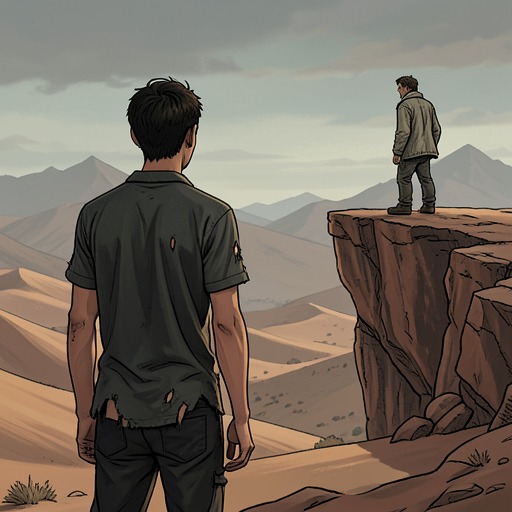
David remains apart from the household as the funeral approaches. Anouar tells him he will return at dusk and advises him to sleep. David quietly bolts the door as ordered. From the window he watches windblown acacia thorns and the shadow of the cliff move toward the house; his phone has no signal. He tries to settle himself, aware that Driss will soon be buried in the small cemetery behind the houses, where a few white stones mark ancestors who have largely been forgotten. The separation places David close enough to hear what is happening, but not among those taking part in the mourning.
The Burial and Abdellah’s Memory
The funeral passes quickly. The plot of gravestones lies in the desert as the sun goes down, and the wind makes the site difficult to endure. Driss’s mother died years earlier; the women who weep and curse are his aunts and cousins. The men stand in silence, carrying their grief inwardly as debris blows around them. The contrast between audible mourning and the men’s stillness gives the ceremony two outward forms, without making the loss any less present.
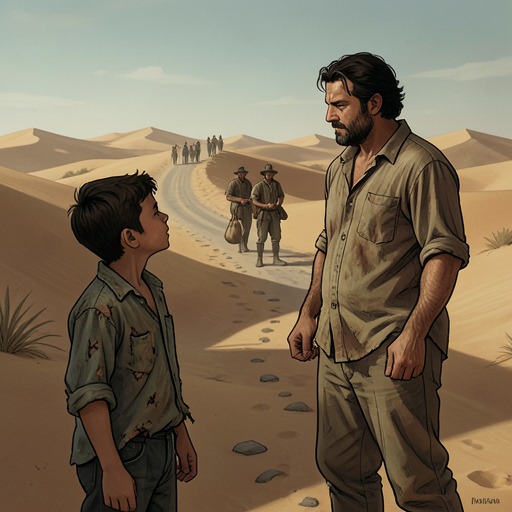
As Driss’s body is lowered into its place and prayers are said, Abdellah remembers his son not as the man whose death has brought them there but as a ten-year-old boy. He recalls taking Driss prospecting alone across the mountain and the boy’s young face, marked by freckles. He also remembers finding a Dicranurus together near the trenches. That trilobite remains in Driss’s room, so the memory joins the funeral to an object left behind: a trace of the father and son’s shared time in the landscape where Driss later searched for fossils. Abdellah’s tears have run out; what remains is the act of seeing and remembering.
David’s Vigil and the Unresolved Question
David does not witness the burial directly. After sleeping through his customary nightmares, he wakes to the red light of dusk on the cliff and initially assumes the ceremony has already ended. Its brevity confirms that it has. His exclusion is practical as well as emotional: he is kept in Driss’s room, waiting without a phone signal and without knowing when he will be called. The burial therefore reaches him through sound, anticipation, and the knowledge that the people mourning Driss are not sharing the room with him.
While he waits, David turns over his sense of approaching doom and the state of his marriage to Jo. He thinks of his irritability and withdrawal, and of the forgiveness he may eventually need. He tells himself that he has done nothing wicked and that events have accumulated as accidents, then questions whether people produce such accidents through small acts of neglect. His reasoning does not resolve his guilt. Instead, the funeral’s approach makes his effort to classify what happened as accident feel provisional: the question of responsibility remains open.
Abdellah’s Decision After the Funeral
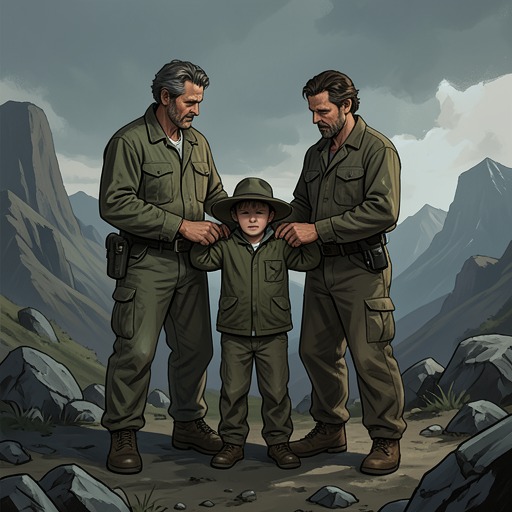
After the burial, Abdellah goes to the edge of the village and waits for Anouar to return on foot from Tabrikt with Ismael. During the journey from Azna, Abdellah had considered what to do to David, but he has not reached a decision. His attention is fixed on a different question: whether David will tell him truthfully how Driss died. Abdellah has waited until the burial is over and until he can speak with Ismael before deciding what should happen.
For Abdellah, the distinction between an accident and a lie is decisive. He regards the accident as not attributable to deliberate intent, but sees a lie as a specific, willed act for which the speaker is personally responsible. A truthful account could lead to an ending different from the one produced by deception; a lie, he believes, would be harder to forgive than the accident itself. The funeral thus does not conclude the conflict or deliver immediate absolution. It marks the point after which Abdellah makes honesty the condition for judging David, placing the possibility of forgiveness alongside grief rather than treating it as grief’s automatic consequence.